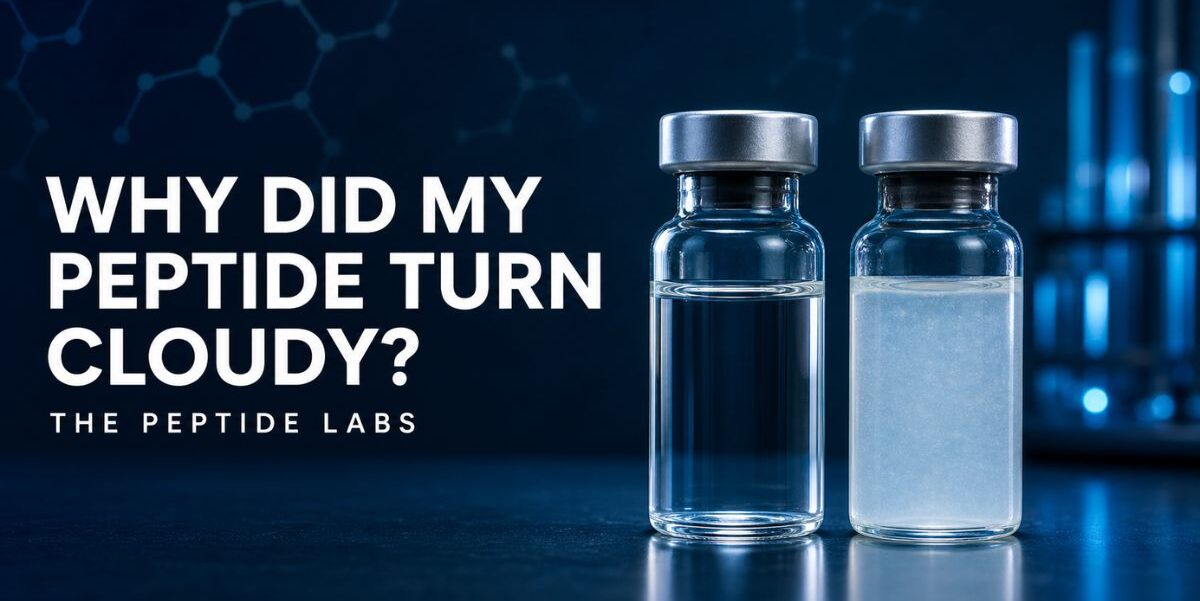
A cloudy peptide solution can indicate aggregation, precipitation, contamination, or incompatibility between the peptide and its preparation conditions. When a reconstituted sample becomes unusually thick, stringy, or gel like, researchers should stop and investigate the change before using it in further experiments.
This change does not automatically prove that the original peptide was defective. However, cloudiness should never be dismissed as harmless. Several different physical, chemical, and environmental factors can produce a similar visible appearance.
Because visual inspection alone cannot identify the cause, an affected sample should be quarantined until it has been properly assessed.
Table of Contents
- What May Be Happening Inside the Vial?
- What Causes a Cloudy Peptide Solution?
- Does Cloudiness Mean the Peptide Was Low Quality?
- Can a Cloudy Peptide Solution Be Restored?
- What Researchers Should Do
- How to Prevent Peptide Aggregation and Cloudiness
- Frequently Asked Questions
- Scientific References
What May Be Happening Inside the Vial?
One possible explanation is peptide aggregation.
Aggregation occurs when individual peptide molecules associate and form larger structures. Depending on the peptide and the surrounding conditions, these structures may appear as haze, suspended particles, strands, clumps, increased viscosity, or a soft gel.
Peptide aggregation can be amorphous or highly organized. It may be reversible in some experimental systems and effectively irreversible in others. Its behaviour depends on the peptide sequence, concentration, formulation, and environmental conditions.
Visible inspection only detects relatively large changes. A solution that still looks clear may contain smaller aggregates that require analytical testing to detect. Methods such as chromatography, light scattering, microscopy, and spectroscopy may be needed when sample integrity is critical.
What Causes a Cloudy Peptide Solution?
1. Peptide Concentration
At higher concentrations, peptide molecules encounter one another more frequently. For peptides with a strong tendency to associate, this can increase the probability of aggregation or gel formation.
This does not mean that every concentrated peptide solution will become cloudy. Aggregation behaviour is sequence specific, so appropriate concentration limits should be established for each peptide and formulation.
2. Incorrect pH
The electrical charge of a peptide changes with pH. Under conditions where a peptide has little overall charge, repulsion between molecules may decrease, making molecular association or precipitation more likely.
Even a solvent that works for one peptide may be unsuitable for another. Researchers should follow validated, product specific preparation instructions rather than assuming that one diluent is appropriate for every compound.
3. Temperature Stress
Temperature can affect peptide solubility, molecular movement, and aggregation kinetics. Exposure to excessive heat, freezing conditions, or repeated temperature changes may alter solution stability.
Samples should be stored within the documented temperature range and protected from unnecessary movement between different storage environments.
4. Vigorous Mixing
Shaking, vortexing, foaming, and repeated agitation can expose a peptide solution to mechanical stress and air to liquid interfaces. For sensitive molecules, these conditions may encourage aggregation.
If mixing is required, researchers should use only the technique specified in the applicable laboratory protocol.
5. Incompatible Diluent or Buffer
Buffer composition, ionic strength, preservatives, salts, and solvent quality can influence peptide solubility and stability.
A diluent should not be selected simply because it is commonly used with other peptides. Compatibility should be supported by product documentation, experimental design, or a validated laboratory procedure.
Researchers can review our bacteriostatic water for laboratory research and the preparation information provided with the applicable research material.
6. Light Exposure
Some peptides or formulation components may be sensitive to light. Prolonged or intense exposure can contribute to chemical changes that later affect solubility, stability, or appearance.
Light sensitive samples should be stored in appropriate containers and under the conditions defined by the laboratory protocol.
7. Time After Preparation
A reconstituted peptide does not remain stable indefinitely. Chemical degradation, adsorption to the container, microbial contamination, precipitation, and aggregation may become more likely over time.
There is no universal storage period that applies to every peptide. Stability depends on the compound, concentration, diluent, container, preparation conditions, and storage environment.
Review the peptide storage and handling guidelines and follow the protocol established for the specific research material.
8. Contamination or Foreign Material
Cloudiness is not always caused by peptide aggregation. Microbial growth, fibres, fragments from closures, glass particles, precipitated buffer components, or other foreign material may also change the appearance of a solution.
This is why researchers should not attempt to diagnose an affected sample by appearance alone.
Does a Cloudy Peptide Solution Mean It Was Low Quality?
Not necessarily.
A peptide that initially met its identity and purity specifications may still become unstable after preparation if the concentration, pH, solvent, temperature, light exposure, or handling conditions are unsuitable.
At the same time, cloudiness cannot prove that a sample remains acceptable. Product purity before preparation and solution stability after preparation are related but separate quality questions.
A proper investigation should consider both the original material and everything that happened during preparation, handling, and storage.
Can a Cloudy Peptide Solution Be Restored?
Researchers should not automatically add more diluent, heat the vial, shake it, filter it, or attempt to make it look clear again.
A visual improvement does not demonstrate restored identity, purity, concentration, sterility, or biological activity. Additional manipulation can also remove material or make the original cause harder to investigate.
If the solution does not match its expected appearance, the appropriate response is to quarantine it and follow the laboratory’s deviation or sample investigation procedure.
What Researchers Should Do
- Stop and quarantine the sample.
Clearly label the vial and prevent further experimental use until its condition has been evaluated.
- Document the observation.
Record the date, time, peptide concentration, diluent, storage history, preparation method, and appearance. Photographs taken under consistent lighting can help with the investigation.
- Review the preparation process.
Confirm the peptide identity, solvent, buffer, pH, concentration, diluent lot, container type, storage temperature, and mixing procedure.
- Compare the sample with appropriate controls.
Where available, compare the affected sample with a freshly prepared control or approved reference sample under the same viewing conditions.
- Contact the supplier.
Provide the product name, batch number, preparation details, storage history, photographs, and a clear description of the observed change.
- Perform analytical testing when justified.
Depending on the research objective, suitable methods may include high performance liquid chromatography, size exclusion chromatography, dynamic light scattering, microscopy, or spectroscopy.
- Discard uncertain material according to laboratory procedures.
If the cause cannot be established or the sample no longer meets the applicable acceptance criteria, it should not be used for data generating work.
How to Prevent Peptide Aggregation and Cloudiness
- Use preparation and storage conditions established for the specific peptide.
- Prepare only the amount required by the experimental protocol.
- Avoid unnecessary agitation, foaming, light exposure, and temperature changes.
- Use properly documented solvents, buffers, containers, and laboratory equipment.
- Confirm that the selected diluent is compatible with the research material.
- Label every prepared sample with its concentration, diluent, preparation date, storage conditions, and responsible researcher.
- Maintain complete records so unexpected results can be traced and investigated.
Why Peptide Solution Stability Matters
Peptide solution stability directly affects research consistency. If aggregation, precipitation, or degradation changes the amount of soluble peptide in a sample, experimental results may no longer represent the intended concentration or condition.
Using an affected sample can introduce avoidable variability between experiments. Careful preparation, documentation, storage, and sample inspection help researchers maintain more consistent study conditions.
Final Thoughts
A cloudy peptide solution, visible particles, thickening, or gel formation can indicate aggregation or another important physical change. These observations do not identify the cause and should not be used alone to judge sample quality.
The appropriate scientific response is to pause, document the event, review all preparation variables, and use suitable analytical methods before deciding whether the sample remains acceptable for research.
For questions involving a product from The Peptide Labs, please contact The Peptide Labs support team with the product name, batch number, preparation details, storage history, and clear photographs of the vial.
Research Use Only: All products supplied by The Peptide Labs are intended strictly for laboratory research. Products are not intended for human consumption, medical use, or veterinary use.
Frequently Asked Questions
Why does a peptide solution become cloudy after preparation?
A peptide solution may become cloudy because of aggregation, precipitation, unsuitable pH, excessive concentration, temperature stress, agitation, contamination, or an incompatible diluent. Appearance alone cannot confirm the cause.
Does a cloudy peptide solution always mean contamination?
No. Cloudiness may result from aggregation or precipitation, but contamination cannot be excluded through visual inspection alone. The affected sample should be quarantined and investigated according to the applicable laboratory procedure.
Can a cloudy peptide solution be made clear again?
Researchers should not automatically add more diluent, heat, shake, or filter the sample. A clearer appearance does not demonstrate restored identity, purity, concentration, sterility, or stability.
How can peptide aggregation be reduced?
Researchers should follow product specific preparation conditions, use compatible laboratory materials, avoid unnecessary agitation and temperature changes, and maintain complete preparation and storage records.
Does cloudiness prove that the original peptide was defective?
No. A peptide may meet its original identity and purity specifications but become unstable after preparation because of concentration, pH, solvent compatibility, temperature, handling, or storage conditions. A documented investigation is required to determine the most likely cause.
Scientific References
- Factors Affecting the Physical Stability and Aggregation of Peptide Therapeutics
- Fibril Nucleation Kinetics of a Pharmaceutical Peptide
- Aggregation Behavior of Structurally Similar Therapeutic Peptides
- Concentration and pH Dependent Oligomerization of a Research Peptide
- FDA Guidance on Visible Particulates
- USP Guidance on Visible Particulates